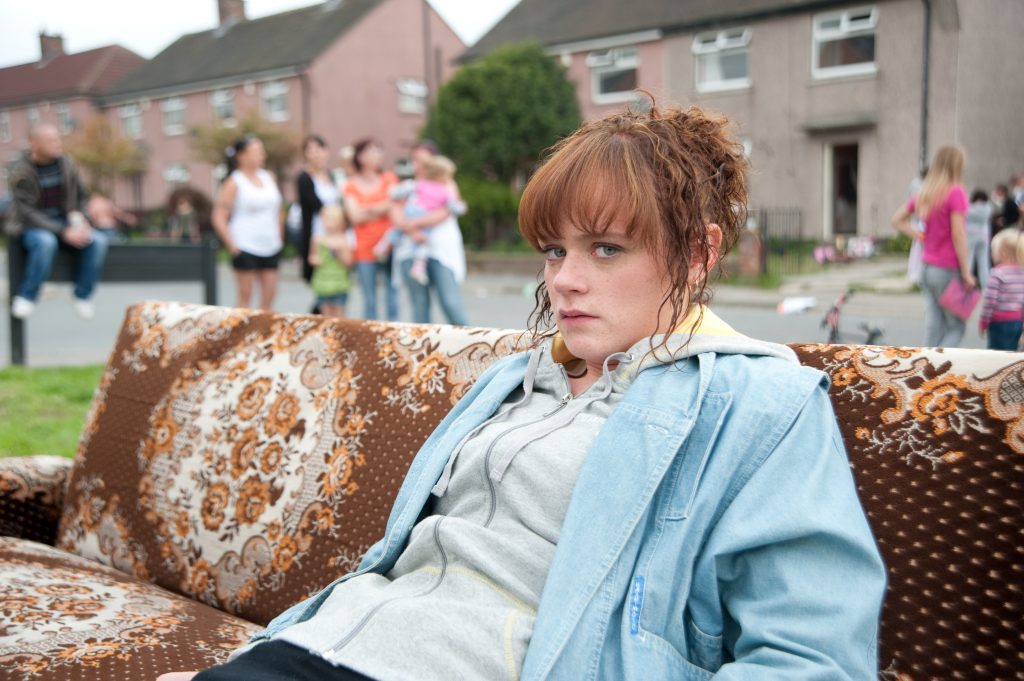
Artist Clio Barnard’s moving film about the late Bradford playwright Andrea Dunbar is an intriguing mix of interviews with Dunbar’s family and friends, scenes from her plays, and TV footage of Dunbar in the 1980s.
Andrea Dunbar, a tenacious young playwright whose work was described as ‘Thatcher’s Britain with its knickers down’, grew up on the notorious Buttershaw Estate in Bradford. It was there that she wrote her three plays The Arbor, Rita, Sue and Bob Too and Shirley, had her three children, and died prematurely, at the age of 29, in 1990. Clio Barnard’s film The Arbor follows Dunbar’s oldest daughter Lorraine as she is introduced to her mother’s plays and letters. Barnard spent two years interviewing members of the Dunbar family and local residents before creating an audio screenplay that was lip-synched by actors. The result, as Peter Bradshaw wrote in The Guardian, is ‘a new kind of ‘verbatim cinema’ … a modernist, compassionate biopic.’
The Arbor was introduced by Falmouth-based artist and writer Dr Neil Chapman, who describes it as ‘a film with a subtle politics developed in an innovative way’.
The Arbor is part of The Artangel Collection, an initiative to bring outstanding film and video works, commissioned and produced by Artangel, to galleries and museums across the UK.
NEIL CHAPMAN: INTRODUCTION
While considering The Arbor (2010) as a film to show at CAST, I have been pleased to come across director Clio Barnard’s endorsements of Alan Clarke and Errol Morris. Along with Barnard’s work, films by both Clarke and Morris featured on my short list.
Alan Clarke’s Elephant (1989) presents a sequence of scenes unrelated to each other except that each one reconstructs a sectarian murder in Northern Ireland. The film is remarkable for many reasons, but primarily for its refusal to frame these killings in terms of the allegiances held by any of its protagonists. Before the violence—before the gun is pulled—most often there is nothing to indicate which of the men on screen will be the shooter, which the victim. As the film progresses, the everyday details of the scene seem to take on more significance. The violence comes to be as banal as the settings. And meanwhile the trauma of a whole community beyond the frame is made more palpable.
The Errol Morris film on my list is another evoking real-life events. Mr. Death: The Rise and Fall of Fred A. Leuchter, Jr. (1999) recounts the story of an American engineer responsible for designing and building execution equipment used by authorities in the US. At least, that is how it starts. The narrative takes an unexpected turn when Leuchter appears as a supposed expert witness for the defence in the trial of Holocaust denier Ernst Zündel. Like Clarke’s film, Mr. Death catches the viewer off guard. As its story swings without warning toward urgent political territory, it exposes the way that conventional narrative structures give rise to assumptions. Viewers become conscious of themselves as viewers of a film that refuses to proceed as expected.
My incentive with these choices—whether advisable or not—has been to develop a point about politics and art. I’ve been thinking about an essay I read many years ago in Afterall Journal on the work of artist Thomas Hirschhorn. The piece begins with a series of quotes. In one, Hirschhorn makes a distinction between ‘political art’ and ‘art made politically’, aligning himself with the latter. The formula is trite. But it does expose a pattern of thought that often turns up in discussion, and that needs to be interrogated for that reason.
In another of the short quotes Hirschhorn is reported as saying: ‘I’m not here to show that I’m able to control things well. That’s what I call working politically.’ This is the more surprising of the two. And it provides a way of thinking about what connects Barnard to her cinematic mentors.
The Arbor is a feature-length documentary about the life of playwright Andrea Dunbar, whose career was cut short by her death, aged 29. The film is a story of deprivation and its effects across generations, most notably in the life of her eldest daughter Lorraine, whose drug addiction led to her imprisonment for gross negligence following the death of her child. Over an extended period, Barnard recorded audio interviews with Lorraine, and with Dunbar’s other children, her ex-partners, extended family, and neighbours. The decision to avoid the use of a camera during these early stages of the work was purposeful and carefully judged as a way of lightening the load on her interviewees. When this phase of the work was completed, the recordings were made into a verbatim screenplay, with actors employed to lip-synch the original voices.
Barnard’s way of working empowered her interviewees. It also gives rise to new complications. Even while the performances are compelling, a subtle interruption comes into the material. The mismatch between voice and face undermines the viewer’s immersion in the story. To watch the film is to be brought back continually to the fact of watching, and to the question of what it means for these events to be represented in the way they are.
Along with the dramatic reconstructions, the film includes scenes from Dunbar’s first play, staged on the council estate where the playwright grew up. Archival television footage is also included, and Barnard’s present-day filming of the estate. The structure is intricate. Orientation is sometimes offered through on-screen text, but beyond that the complexity is left as a testament to the impossibility of adequately telling a story of lives unfolding over a period of decades.
As Barnard’s practice has diversified, she has been asked to comment on her apparent shift towards more mainstream filmmaking. She resists that framing, but still consents to talk about The Arbor as ‘experimental’. To my mind the term does not serve her well. It suggests a filmmaker trying out one method among several. The formal decisions in The Arbor don’t feel as if they have been optional. The use of verbatim audio and lip-synch appears as a necessity arising from the material itself. Barnard works with the difficulty. The film evolves not by removing obstacles but by incorporating them, its form registering the strain of telling the story.
The question of politics in filmmaking returns here in a more specific form. Barnard clearly begins with a political concern. She chooses to make a film about a playwright from a working-class background and about the consequences of deprivation across generations. That focus matters. It determines who is seen and heard, and whose experience is granted weight. But the force of The Arbor does not lie simply in its subject matter. It lies in a tension created by the film’s own methods: techniques designed to empower the speaker give rise to new forms of distance and interruption. The mismatch between voice and body makes it impossible to mistake testimony for transparency. The limits of documentary authority become evident, as do the limits of the director’s control. What emerges is not the expression of a fixed political position, but a form shaped in response to its own constraints. Hirschhorn’s remark returns here with renewed clarity. The refusal to ‘control things well’ offers no guarantee of fidelity to a prior political commitment. But it does suggest what it might mean to make a film politically.
Delivered on Thursday 29 January, 2026.
© Neil Chapman