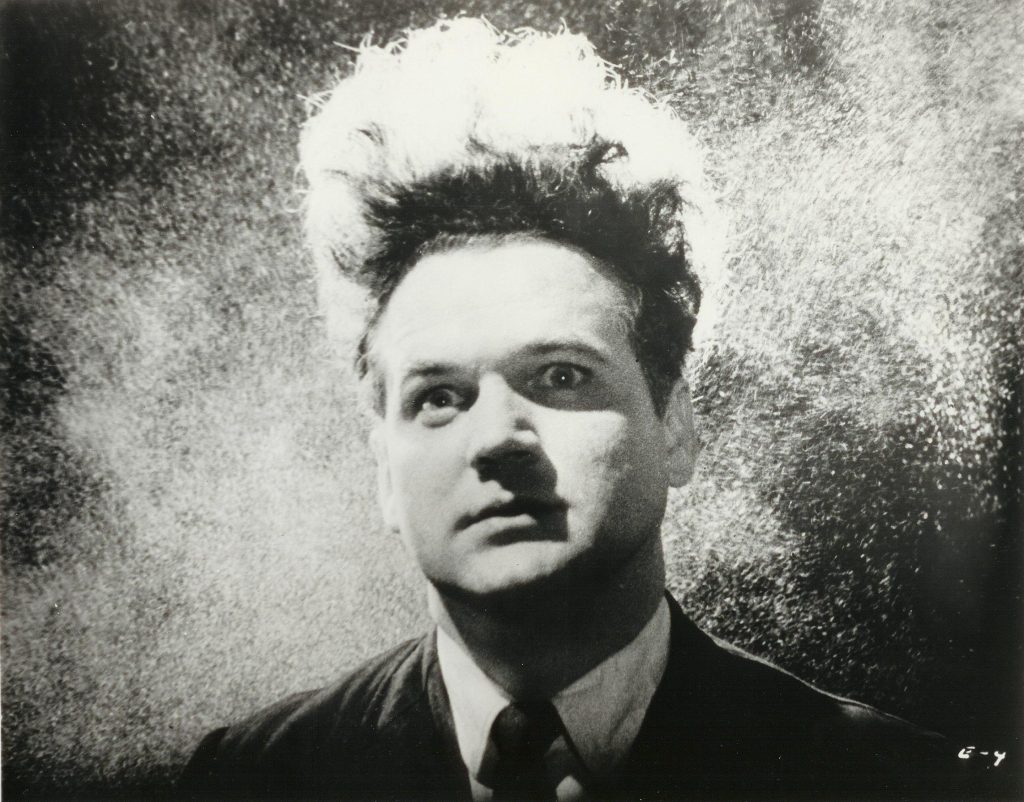
David Lynch’s 1977 dystopian debut Eraserhead tells the story of a young factory worker who discovers unexpectedly that he is to become a father. In typical Lynchian surrealist fashion, after moving in together the young couple struggle with the challenges and demands of becoming new parents. Lynch described the film as ‘a dream of dark and troubling things’.
The film stars Jack Nance, who would go on to be a long-term collaborator with Lynch through a recurring role as Pete Martell in Twin Peaks. Lynch created the film’s iconic score and sound design, which echoes the desolate industrial landscape in which the film is set. Despite an initially mixed reception, Eraserhead is now widely seen as a cult classic and cited by Stanley Kubrick as his favourite film, with its influence apparent in both Alien and The Shining.
Born on 20 January 1946, David Lynch died on 15 January 2025. Eraserhead was selected and introduced by Helston-based psychoanalyst and DJ Tom Greenall as a tribute to the influence of Lynch’s work and life on Tom’s own practice.
TOM GREENALL: DREAM LOGIC
David Lynch viewed the world differently – and dared his audiences to do the same.
Where others saw the mundane, Lynch imagined what lies beyond and devoted his life to uncovering the wonder and strangeness of what it is to be human. Standing here this evening and trying to quantify the legacy of one of the most influential cultural figures of the twentieth century feels like a futile endeavour. Clearly, Lynch has left an indelible mark on contemporary art and culture, but what he actually represents is far more difficult to articulate. His magic exists somewhere beneath the surface, just out of reach.
Lynch has described growing up in 1950s post-war America in idyllic terms: ‘My childhood was picket fences, blue skies, red flowers and cherry trees’, but then, ‘I would see millions of little ants swarming on the cherry tree, which had pitch oozing out of it.’ He seems to have been a savvy kid, who hungered for a sophistication hard to come by if you were from Boise, Idaho. He has spoken of having had a longing for something out of the ordinary, in an epoch when television was beginning to bring alternative realities into the homes of America and was beginning to chip away at the unique regional character of towns and cities throughout the country. He’s recalled childhood memories of darkness and light. Perhaps his father’s academic work with the forestry commission working with diseased tress had given him a heightened awareness of what he has described as ‘The wild pain and decay which lurks beneath the surface of things’. For whatever reason, Lynch was unusually sensitive to the entropy that instantly sets in and begins eating away at every new thing.
He draws on childhood in a lot of his work, but his creative drive and the things he’s produced cannot be explained so simply. As many analysts know, you can analyse someone’s childhood looking for clues to explain the person the child grows up to be, but generally there is no inciting incident, no rosebud. Ultimately, we come in with some of who we are. Lynch came in with an unusually intense capacity for joy and a desire to be enchanted. Confident and creative from the start, he wasn’t the kid buying screen-printed t-shirts. He was the kid making them.
In the following I’d like to speak about Eraserhead and Lynch as an auteur.
The look of a Lynch film is largely shaped by Lynch‘s unique relationship with time and the fact that he feels no responsibility for historical accuracy in relation to period styles. Lynch’s America is like a river that flows on, carrying odds and ends from one decade into the next, where they intermingle and blur. Lynch was living in Philadelphia at the time that Eraserhead began to crystallise in his mind. He has commented that he didn’t think the film through in his head – but felt it. The mood of late 60s and early 70s Philadelphia is palpable here: a broken city in the years following World War II, where a housing shortage, coupled with inter-racial tensions, started a wave of white flight, and where, from the 1950s to the 1980s, the city’s population steadily dwindled.
Race relations in the city had always been fraught and during the 1960s Black Muslims, Black Nationalists and a militant branch of the NAACP (National Association for the Advancement of Coloured People), a prominent American civil rights organisation, played key roles in the birth of the Black Power movement and ratcheted up tension dramatically. Animosity simmered between hippies, student activists, police officers, drug dealers and members of the African American and Irish Catholic communities, often reaching boiling point and spilling onto the streets.
For me, watching Eraserhead never gets less disturbing. One never loses the sense of a small but indelible psychic trauma. ‘A dream of dark and troubling things’, Lynch called it. It was, and is, a film that people view as a demarcator. When I first watched it, I had no idea what I was looking at. But in the days that followed I wondered if it was a surreal exploration of masculinity, or of male terror of and aversion to dependency, or of the female psyche and the erotic.
The narrative portrays a young man named Henry Spencer, living in a dismal post-industrial dystopia. He meets a girl named Mary and she falls pregnant. Henry is gripped by anxiety at the arrival of the Lynchian infant, an alien baby depicted in its most primitive and rawest form. Somewhat akin to the Freudian drives, its being predates the developmental ontology of a human infant. We see and feel Spencer experiencing the mystery of the erotic and the alien demands of fatherhood, as his psyche is consumed by fantasies of death and the divine. In an uncanny sense, it’s a story about grace. The screenwriting style is direct and clear and the script has the rigour and exactitude of a Beckett play. Just 21 pages long, it has minimal stage direction and mostly focuses on evocative description. It’s apparent that the film’s sinister and oppressively malevolent mood is of primary importance to Lynch.
Lynch started shooting Eraserhead in June 1972. He built the set entirely with his brother, John Lynch, lead actor Jack Nance, Catherine Colson and Doreen Small, constructing Henry’s world largely out of scavenged materials. It is some kind of miracle that he did so much with so little, re-purposing and repeatedly reusing the meticulously built set to provide an apartment lobby, a theatre stage, a pencil factory, a suburban home, an office and a front porch. Doreen Small scoured flea markets and thrift stores for clothing and props and Colson emptied her own living room to furnish the lobby of Henry’s apartment. Colson‘s aunt was a particularly valuable resource. A designer for a bathing suit company in California, she lived in a seventeen-room house in Beverly Hills, with a basement full of stuff that Colson and Lynch dug through when looking for props. This source produced the humidifier for the baby scenes.
Colson recalled Eraserhead included things considerably more offbeat than a humidifier. ‘I had to find some real unusual things’, she recalls. ‘David wanted a dog with a litter of nursing puppies, so I called around to find people who had dogs with new litters and asked if they’d loan us their dogs’. The Eraserhead baby was christened ‘Spike’ by Jack Nance and was the most crucial prop in the film. Lynch began working on it months before the shoot started. He never divulged how he made it, and neither have any of the cast and crew. The umbilical cords in the film are real. Coulson recounts having to lie to several hospitals, telling them the cords would just be in jars in the background in a movie scene. In total five or six were sourced and nicknamed ‘billy cords’ on set. The cast for Eraserhead was small, and the crew even smaller – often only Colson, who did everything from rolling paper, to making it look as if the elevator in Henry’s apartment was moving. Colson was working as a waitress at the time and often contributed tips and food to the production. Lynch has always been clear that the film could not have existed without her input.
While Lynch talks of the film as a product of his art student days at the Philadelphia Art Institute, it was shot wholly in Los Angeles, with the assistance of the American Film Institute, and across AFI-owned locations such as Greystone Manor, home to the original AFI Conservatory, and the disused stables where Lynch lived while shooting it. Watching it can feel like a ghost story of near-contemporary urban paranoia. It was shot entirely at night and the menace of the city bubbles under it. There were no windows in the set and Henry’s wider world is a mystery. The film lives in uncanny darkness, drawing from both the macabre and the mundane.
During filming Lynch ran out of the funding the American Film Institute had given him to make the film. By the spring of 1973 he was told he could continue using school equipment, but no additional funds would be forthcoming. Eraserhead went on hold and this continued intermittently for almost a year, with Lynch under financial and significant time pressure to finish filming. One day he was sitting in the food room sketching and a figure that came to be known as ‘the lady in the radiator’ took shape on his drawing pad. The character became the one needed to bring Henry’s story to a close and came to represent a place of protection, unity and hope. Her arrival in the film marks a shift in the narrative trajectory and allows the film to conclude on a note of optimism and possibility.
From the summer of 1975 until early 1976 Lynch cut the picture, while sound director Allan Split cut the score and soundtrack. It was during these eight months of intensive collaborative work that Eraserhead became the masterpiece that it is. For me, there’s an almost unbearable tension in the layers of sound that form the soundtrack. It is as complex as it is rich – from the mad barking of a dog to the whistle of a distant train and the malevolent presence of turning machinery, to the form and tone of a hollow room that’s close to the very embodiment of loneliness and isolation.
Many have commented on Lynch’s ability to capture the zeitgeist. Eraserhead came along at an opportune time, just as precisely the sort of audience capable of appreciating it was coalescing in Los Angeles. At first, it became a quiet word-of-mouth movie on the midnight movie circuit and was shown in the early days of what turned out to be a four-year run at the Nuart Theatre. Radical performance pieces were gathering momentum and publications like Wet: The Magazine of Gourmet Bathing and the Los Angeles Reader, which celebrated all things experimental, underground and avant-garde, were flourishing. People from these facets of the city filled the seats of the Nuart and embraced Lynch as one of their own. Pink Flamingos director John Waters encouraged his fans to see it and Stanley Kubrick made his love for the film public.
Lynch’s name started to get around.
Many agree that Lynch was uniquely gifted. For me, he understands the human psyche and emotions of the human heart like many of the greats. He’s all screwed up as well of course. He projects his own emotional and sexual turmoil into his work and assaults us with the feelings he is being assaulted by – and he does that brilliantly. I also find a lot of humour in his work. The humour in struggling and the malaise of sickness and ignorance often based on our pitiful pursuit of happiness, which ultimately leads to misery. I find it fascinating the way people often go on despite the despair they feel.
Lynch’s work is unsettling and always infused with a sense of the other. Where he stands apart from his contemporaries is in his ability to burrow into the microcosm and the detail of the absurd. He found the mystical and surreal in everything and lavished attention on the smallest amount of dirt, or a tiny scrap of fabric encompassing the minutiae of everyday life.
His work has no doubt launched thousands of graduate papers, but you can’t reduce it to a collection of Freudian symbols. The elements of his film are simply too complex and multi-layered for neat and tidy synopsis. For me, his work operates in the mysterious unconscious territories that separate our daily reality from the fantastic realm of human imagination, desire and the longing pursuit of things that defy explanation or understanding. I’ve always loved the fact that his work is to be felt and experienced rather than understood theoretically.
During the opening moments of a Lynch film, you’re immediately thrust into a world where everything feels real, yet unreal, everything is perfect, but you can’t trust it, and then you descend into the abject and the underbelly. People often don’t know whether they are supposed to laugh or run from their seats during a Lynch film. Audiences are now quick to find unusual things hilarious or delicious, but Lynch’s bravery when it comes to tone was like nothing we had seen before. Before Lynch, nobody in the same way made it sad and funny at the same time, or terrifying yet hilarious, erotic and odd.
American film critic Pauline Kael saw Lynch as a popular surrealist – defining his work as ‘an inquiry into the mystery and madness hidden in the normal’. Kael highlights ‘Lynch’s use of irrational material that works on an unconscious level’. It is this that initially drew me in and ultimately opened new Lynchian frontiers to me.
With that said, many would define him as a perverse director. I don’t think provocation is Lynch’s desire, but his work always has complexity, depth and layers of meaning, which can be frustrating if one feels that one is supposed to understand a film that can’t be distilled into a simple story. His work is undoubtedly bold and at times provocative. I enjoy his challenge to the veracity of linear time and much of his work could be seen as an elaborate hallucination. It could never really be mistaken as the work of anyone else.
I’ve come to think of David’s Lynch’s work as a wholly fascinating look into the psychosis of the human mind, and for me it is up there amongst some of the most inscrutable, difficult yet gripping works of film ever made.
Thanks for everything David x
Delivered on Thursday 24 April, 2025.
© Tom Greenall